WebRTC Communication Support Comes to Cognibase


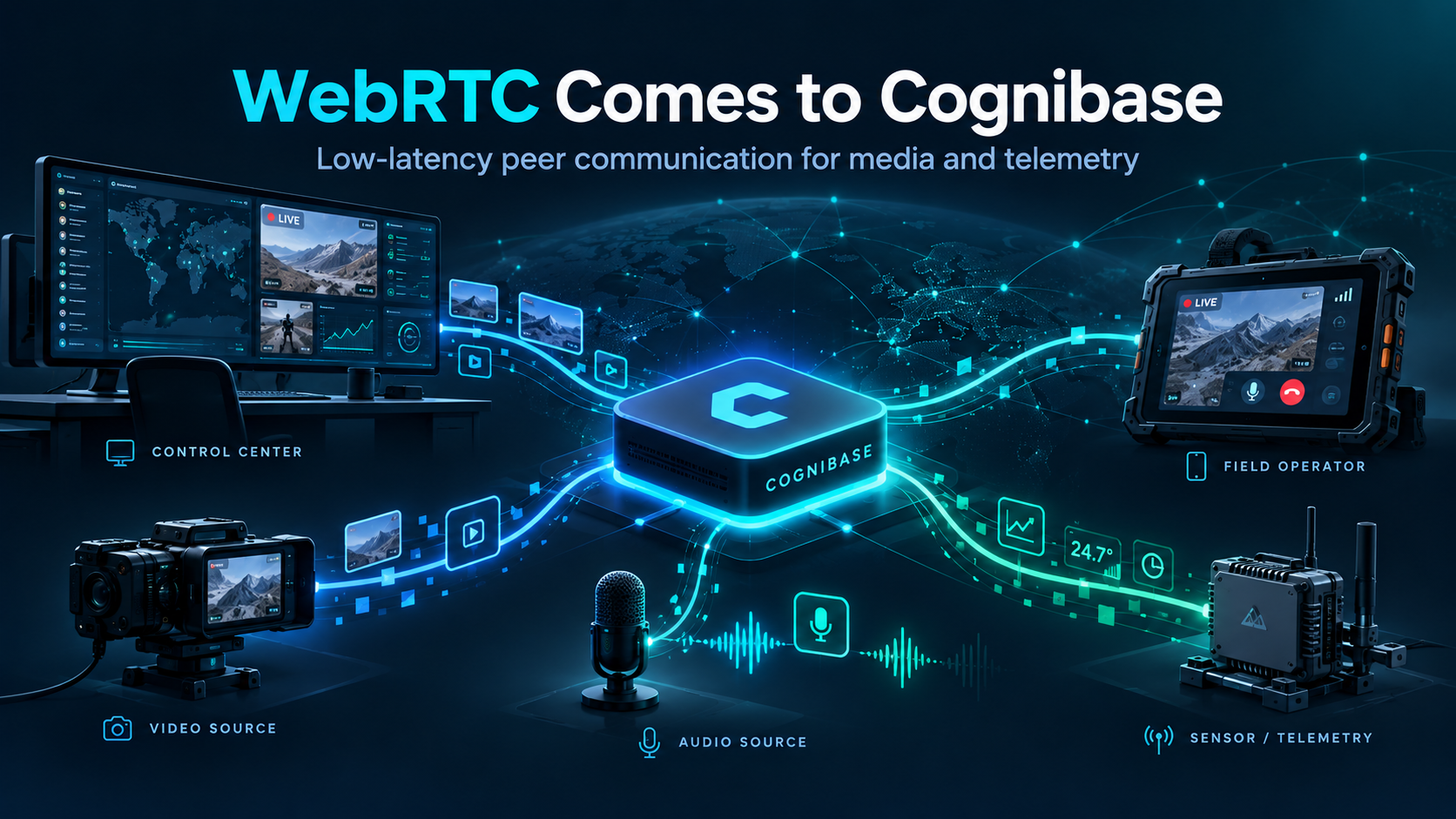
We recently added WebRTC-based peer communication support to Cognibase, expanding the connectivity options available for building distributed, real-time applications.
This addition is especially valuable for media and telemetry workloads: live video/audio streaming and sensor data streaming between distributed nodes.
Cognibase is designed as a memory-first, real-time .NET platform where domain objects and their state are synchronized across clients, services, and edge nodes. Its communication layer has traditionally supported technologies such as WebSockets and Named Pipes as part of this distributed architecture.
With the new WebRTC integration, Cognibase applications can also establish direct peer-to-peer communication channels optimized for low-latency data exchange. In practical terms, this is highly relevant for scenarios such as:
- live video from field teams
- real-time audio communication streams
- continuous sensor telemetry from remote equipment
These capabilities are particularly important in mobile field operations, where situational awareness depends on fast and direct communication from the field.
The implementation is being delivered through the Cognibase communication libraries, including dedicated packages for core WebRTC functionality as well as platform support for Windows and Android.
WebRTC is fully integrated with Cognibase. The Cognibase backend can act as the signaling server for peer session setup, and it can also integrate with external WebRTC-based services when broader interoperability is needed.
WebRTC is especially interesting to us because it complements the distributed nature of Cognibase. A Cognibase node may run in a control center, on a workstation, on a mobile device, or close to a physical system at the edge. The platform already targets Windows, Linux, mobile, web, and cloud/edge environments.
For crisis-management and incident-response systems, this matters a lot: video from the field, audio channels, and sensor streams can be routed where decisions are made in near real time. WebRTC now adds a communication option tailored to these direct, media-rich, real-time interaction patterns.
This is still an evolving part of the Cognibase communication stack, and we will share more technical details and examples as the integration matures.
More to come.